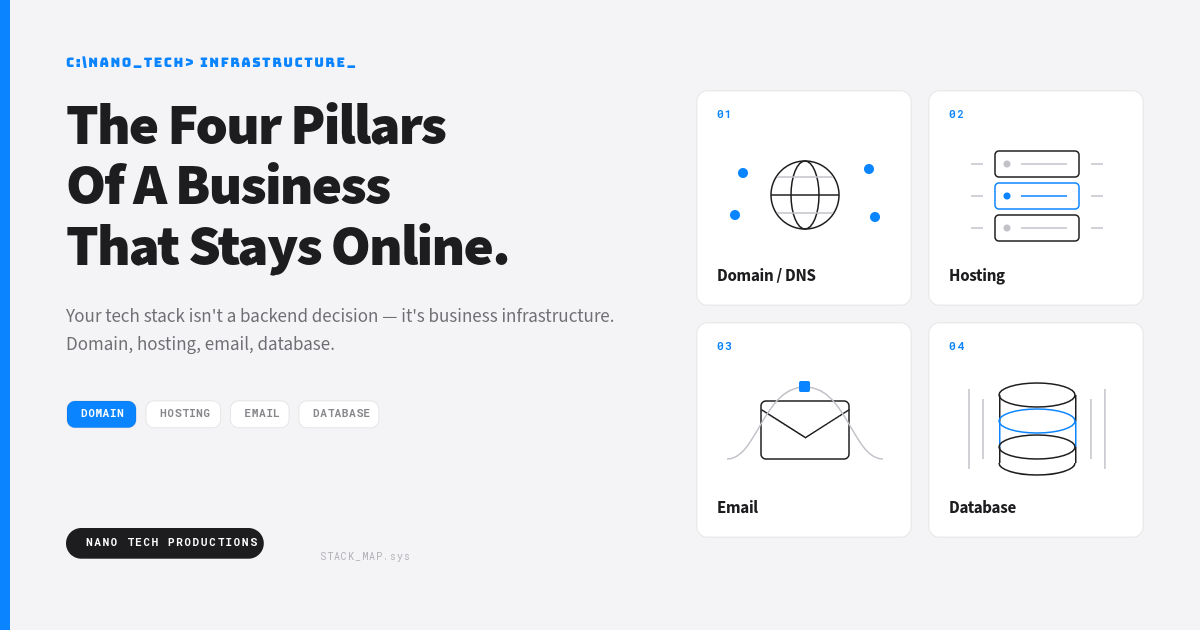
The Four Pillars Of A Business That Stays Online.
Choosing your tech stack isn't just a "backend" decision — it's the foundation of your business infrastructure. If your site goes down, your email hits spam folders, or your database lags, your brand equity evaporates instantly.
Domain: Your Digital Real Estate
Your domain is your identity. You need a registrar that offers high uptime for DNS (Domain Name System) so your site remains reachable at all times. A slow or unreliable DNS provider causes "intermittent" downtime that is incredibly hard to troubleshoot but devastating for SEO and user trust.
Recommended providers
- Cloudflare — highly recommended for integrated security and fast DNS.
- Namecheap
- Google Domains (Squarespace)
Hosting: Your Physical Foundation
Hosting is where your files live. For a growing business, you need a provider that prioritizes speed and uptime over "budget" pricing. Slow hosting directly impacts your conversion rates — if a customer has to wait 3 seconds for a page to load, they are likely to leave.
Recommended providers
- AWS (Amazon Web Services) — the industry standard for scalability.
- Google Cloud
- Microsoft Azure
Email: Your Primary Communication
Never use a basic "web host" email account for professional outreach. If your emails land in the spam folder, your sales pipeline stalls. Professional providers have "reputation management" to ensure your messages actually reach the inbox.
Database: Your Information Hub
The database is the engine room where your products, user data, and content are stored. It must be optimized for "queries" — the way the site asks for information. A poorly optimized database causes "laggy" experiences, especially on e-commerce sites or high-traffic blogs.
Recommendation
- Use managed database services from AWS or Google Cloud.
- Managed means backups, patching, and scaling are handled for you.
🚩 Four Traps That Create Technical Debt
"Shared" hosting on budget tiers
Unless you're running a personal blog, avoid sharing server resources with thousands of other sites. If another site spikes in traffic, your site slows down or crashes.
Bundled "free" email services
Cheap hosts often throw in free email. Avoid it. Those servers carry poor reputations, so your professional messages are far more likely to be flagged as spam by Gmail and Outlook.
Outdated infrastructure
If a provider never mentions modern tech like NVMe storage or updated server environments, assume old hardware — which means higher latency and slower loads.
No-support environments
No 24/7 technical support and no clear SLA (Service Level Agreement) means you are completely on your own when the site goes down at 3:00 AM.
Decouple everything.
For maximum reliability, split these services across specialists. Use Cloudflare for DNS and security, a dedicated provider like AWS for hosting and database, and Google Workspace for email. That way, if one service has a hiccup, it doesn't take down your entire operation.